

BEYOND THE SMU.
When materials become devices, the M81-SSM and SMU‑10 are ready — world-class DC precision with the AC and lock-in capabilities next-generation devices demand.
KEY CAPABILITIES FOR DEVICE RESEARCH:
 | DC accuracy on par with the world's best DC-only SMU |
| <3 nV/<1 fA AC sensitivity at 1 kHz |
| AC sourcing and measurement to 100 kHz |
| Lock-in detection for signals buried in noise |
| Voltage or current-controlled I-V characterization from DC to 100 kHz |
| Up to 3 synchronized SMU-10 modules for correlated device measurements |
The path from materials research to device development is a critical transition. Where materials researchers need lock-in sensitivity and synchronized multi-parameter measurements, device engineers need something different: the familiar source-measure workflow of the SMU, with the precision to characterize devices at nanometer scales.
Traditional SMUs excel at DC source-measure. But as devices shrink to atomically thin dimensions, DC-only instruments reach their limits. Ultra-low leakage currents, weak AC signals buried in noise, frequency-dependent behaviors — these demand capabilities that conventional SMUs simply weren't designed to provide.
The SMU-10 module for the M81-SSM was designed specifically for this transition. It delivers world-class DC accuracy on par with the best DC-only SMUs — then goes further, adding AC sourcing to 100 kHz and lock-in sensitivity for signals buried deep in noise. All in the familiar four-quadrant SMU format device engineers already know.
The same M81 integration advantage that makes it the ideal materials research platform makes it equally powerful for device characterization: synchronized measurements, unified noise architecture, and a signal path designed and optimized for low-level measurements.
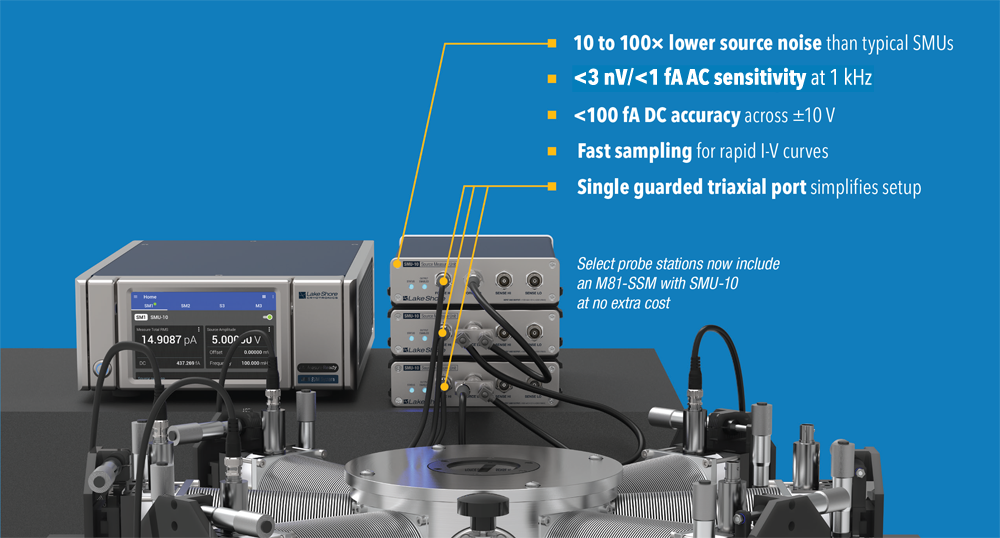
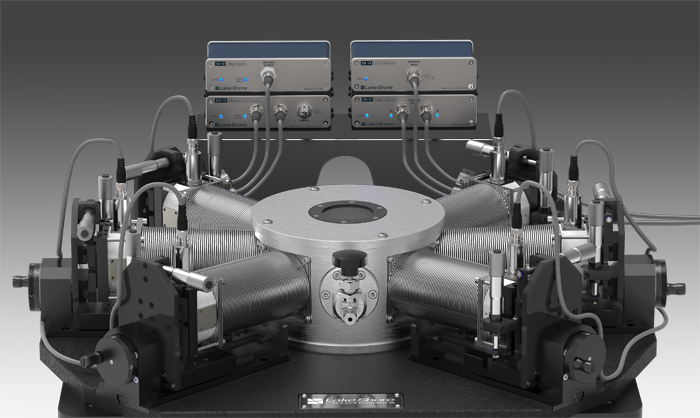
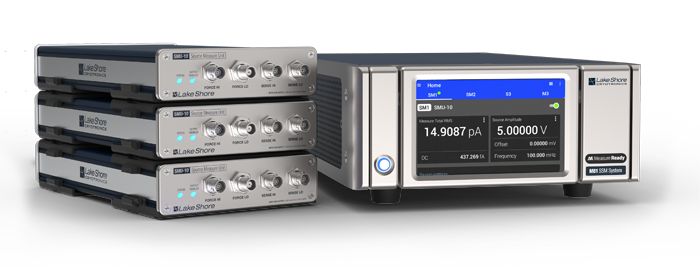
DC VERSATILITY MEETS AC LOCK-IN SENSITIVITY, PURPOSE-BUILT FOR NEXT-GENERATION SEMICONDUCTOR CHARACTERIZATION
Characterizing atomically thin and nanoscale semiconductors demands capabilities traditional DC SMUs simply can't provide. The SMU-10 delivers world-class DC accuracy for precise I-V characterization, dramatically lower source noise than conventional SMUs, and the AC sensitivity of dedicated lock-in amplifiers — all in the familiar four-quadrant SMU format device engineers know.
It's a microcosm of the M81 philosophy: designed and optimized for capabilities that separate instruments can't deliver.
KEY CAPABILITIES FOR DEVICE RESEARCH:
| 10 to 100× lower source noise than typical DC SMUs |
| <3 nV/<1 fA AC sensitivity at 1 kHz |
| <100 fA DC accuracy across ±10 V output |
| Fast sampling for rapid DC and AC I-V curve acquisition |
| Single guarded triaxial port for simplified four-quadrant source/measure |
| Up to 3 synchronized SMU-10 modules in an M81 system |
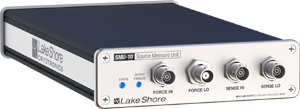
The SMU-10 combines world-class DC accuracy with AC sourcing and lock-in sensitivity in the familiar four-quadrant SMU format. Purpose-built for atomically thin and nanoscale semiconductor characterization.
- 10 to 100× lower source noise than typical DC SMUs
- DC to 100 kHz with or without AC modulation
- Up to 3 synchronized SMU-10 modules for one M81-SSM
FOUR FUNCTIONS. ONE MODULE.
| Ultra-low DC capabilities | DC and AC capabilities | Integrated lock-in | |
| DC current | Offset <100 fA | Sine | — |
| AC current | — | Triangle/square to 5 kHz, sine up to 100 kHz* | <1 fA AC sensitivity |
| DC voltage | Microvolt sensitivity | Sine | — |
| AC voltage | — | Triangle/square to 5 kHz, sine up to 100 kHz* | <3 nV sensitivity |