

BEYOND THE LOCK-IN.
The M81-SSM is purpose-built for the demands of materials characterization, where sensitivity, synchronization, and low noise aren't optional.
KEY CAPABILITIES FOR MATERIALS RESEARCH:
 | Lock-in detection to nanovolt sensitivity |
| <0.0001° RMS phase noise across channels |
| 375 kSa/s synchronized sampling |
| Combined DC + AC measurements from a single unified system |
| Eliminates ground loops, timing errors, and inter-instrument noise compounding |
| Configurable for transport, Hall, impedance, and low-level I-V measurements |
Materials research demands the most sensitive electrical measurements possible. Detecting transport properties in novel semiconductors, characterizing magnetic materials, measuring resistance through phase transitions—these measurements push instruments to their limits.
For decades, the lock-in amplifier has been the cornerstone of sensitive materials measurement. But modern research demands more: simultaneous DC and AC measurements, synchronized multi-parameter data, and noise floors low enough to resolve signals in the most challenging samples.
Traditional approaches mean assembling instruments from different vendors, each with its own clock, ground reference, and noise signature. Ground loops. Timing errors. Compounded noise. Never designed to work together.
The M81‑SSM is.
The M81's lock-in rivals the best standalone instruments (<0.0001° RMS phase noise, >120 dB dynamic reserve) pulling signals from noise that would overwhelm conventional setups. Purpose-built modules, synchronized through a common timebase and unified noise architecture. Designed and optimized for measurements that separate instruments can't deliver.
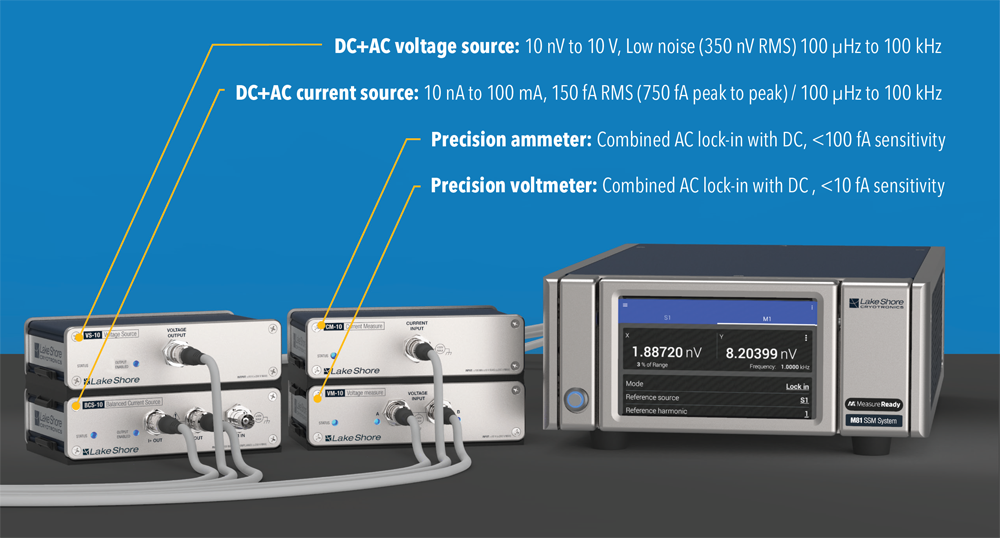
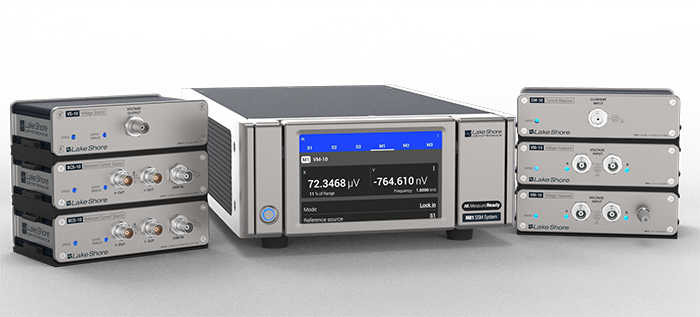
| DC voltage source | 100 nV to 10 V, low noise (350 nV RMS) |
| AC voltage source | 100 µHz to 100 kHz, low noise (40 nV/√Hz at 1 kHz) |
| DC current source | 10 nA to 100 mA, 150 fA RMS (750 fA peak-to-peak) |
| AC current source | 100 µHz to 100 kHz, 20 fA/√Hz at 10 Hz |
| Precision voltmeter | Combined AC lock-in with DC component, <10 fA sensitivity |
| Precision ammeter | Combined AC lock-in with DC component, <100 fA sensitivity |
| Lock-in amplifier | <0.0001° RMS phase noise, >120 dB dynamic reserve |
PURPOSE-BUILT MODULES FOR ULTRA-LOW NOISE AND SENSITIVITY, READY FOR THE MOST DEMANDING SAMPLES
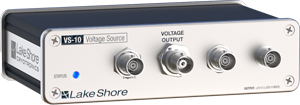
The VS-10 provides programmable voltage from ±1 V to ±10 V with a maximum of 100 mHz compliance, up to 100 kHz. Purpose-built for gate-biasing, voltage-sweep I-V curves, and applications requiring highly stable voltages in combination with current, resistance, conductance, and other material or device measurements.
- 100 nV to 10 V, low noise (350 nV RMS)
- Patented dual AC+DC range for seamless sourcing
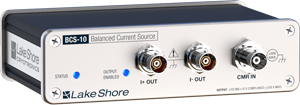
The BCS-10 provides programmable currents from 1 pA to 100 mA with a maximum of 30 V compliance, up to 100 kHz. Its design reduces noise and improves common-mode rejection — delivering source noise performance that significantly improves measurement quality in sensitive applications.
- 10 nA to 100 mA, 150 fA RMS (750 fA peak-to-peak)
- DC to 100 kHz with or without AC modulation
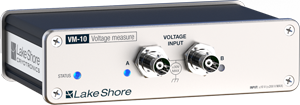
The VM-10 provides voltage measurements with resolution from nanovolts to millivolts, with combined AC lock-in and DC measurement capabilities. Particularly useful for applications requiring numerous range changes including amplitude, phase, and harmonic detection.
- Combined AC lock-in with DC component
- <10 fA sensitivity
- Configurable next to or remote from the M81 instrument for minimum environmental noise pickup
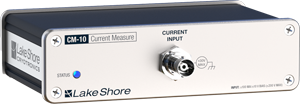
The CM-10 provides current measurements with near-zero input offset voltage from nanoamps to 100 nA, including amplitude, phase, and harmonic detection capabilities. Can be paired with the VM-10 for combined voltage and current measurements.
- Combined AC lock-in with DC component
- <100 fA sensitivity
- Programmable ±1 V voltage bias offset for applications requiring biased current measurements