

Infinite Helium™
Closed‑Loop Helium Circulation for Continuous‑Flow Cryostats
Helium logistics shouldn’t dictate your experiment schedule. Infinite Helium™ transforms a continuous‑flow cryostat into a closed‑loop helium circulation system—so you can run longer, plan with confidence, and dramatically reduce helium consumption at the instrument level. No recovery equipment. No purification. No reliquefaction. Just a sealed, stable helium circuit designed for continuous operation.
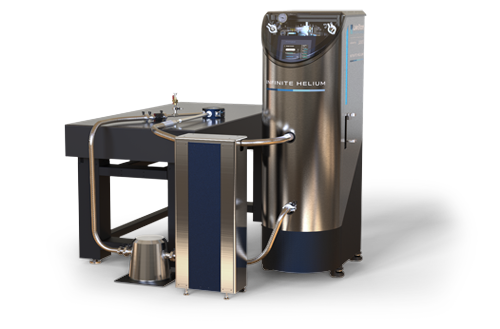
What Is Infinite Helium?
Infinite Helium™ is a closed‑loop helium circulation solution that keeps the same helium moving continuously through your cryostat—without venting to atmosphere. Instead of consuming and exhausting helium during a run, the system circulates it in a sealed loop, maintaining the required flow and pressure for stable cryogenic performance.
Because the helium remains inside the loop from the start, no purification or liquefaction steps are required.
At a Glance
- Converts a continuous‑flow cryostat into a closed‑loop system
- Recirculates the same helium inventory—no vent line to atmosphere
- Compressor‑driven flow for consistent pressure and delivery
- No recovery/purification hardware needed
- Designed for long-duration experiments and repeatable runs
Why Close the Loop on a Continuous‑Flow Cryostat?
Traditional continuous‑flow operation continuously vents helium after use, which creates several challenges:
- High helium consumption: Costs scale directly with experiment duration. See how much you can save using our Helium Calculator.
- Supply dependence: Availability and price volatility affect schedules and budgets.
- Operational interruptions: Running low can force unplanned stops and rework.
- Environmental waste: Vented helium cannot be reclaimed or reused.
Infinite Helium eliminates venting and decouples operation from ongoing helium supply, so your team can plan experiments by science—not by cylinder.
How Infinite Helium Works
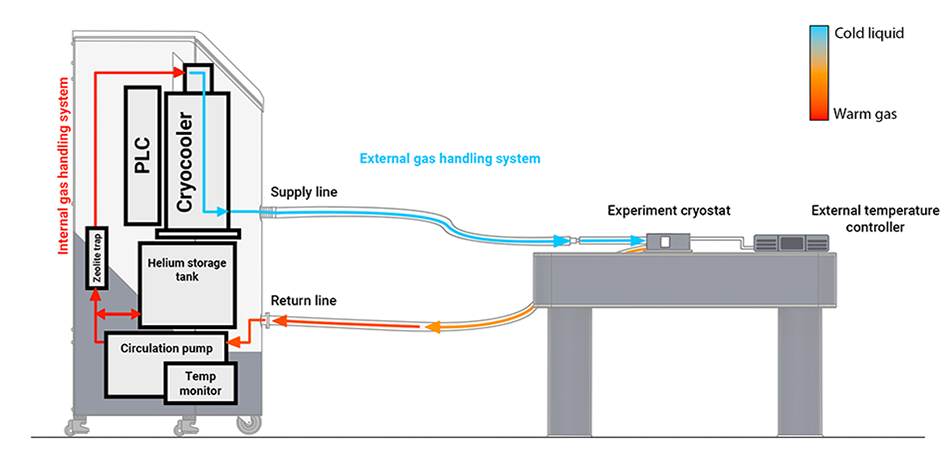
Infinite Helium creates a sealed circulation path between your helium supply and cryostat.
- Flow: Helium flows through the cryostat to provide cooling.
- Return: Warmed helium exits the cryostat and remains inside the sealed loop.
- Recool: A cryocooler cools the helium and returns it to the experiment cryostat.
- Repeat: The same helium continues cycling—hour after hour, run after run.


Applications
Quantum Research & Low-Temperature Physics
- Maintain stable, continuous cooling without planning around helium venting or frequent replenishment.
- Ideal for extended quantum experiments that require predictable cryogenic conditions and uninterrupted low-temperature operation.
Superconductivity & Magnet Testing
- Run long-duration tests with steady helium delivery and minimal logistical overhead.
- Supports consistent magnetic field environments by providing a closed‑loop helium flow that minimizes experimental interruptions.
Cryogenic Materials Characterization
- Improve repeatability and uptime for temperature-sensitive measurements.
- Ensures stable thermal performance across runs, helping researchers gather more reliable and comparable data.
Shared Labs & Multi-Instrument Facilities
- Scale benefits across instruments where continuous-flow cooling is required.
- Reduces overall helium consumption and simplifies resource management for facilities serving multiple users or experimental setups.
Cost & Operational Impact
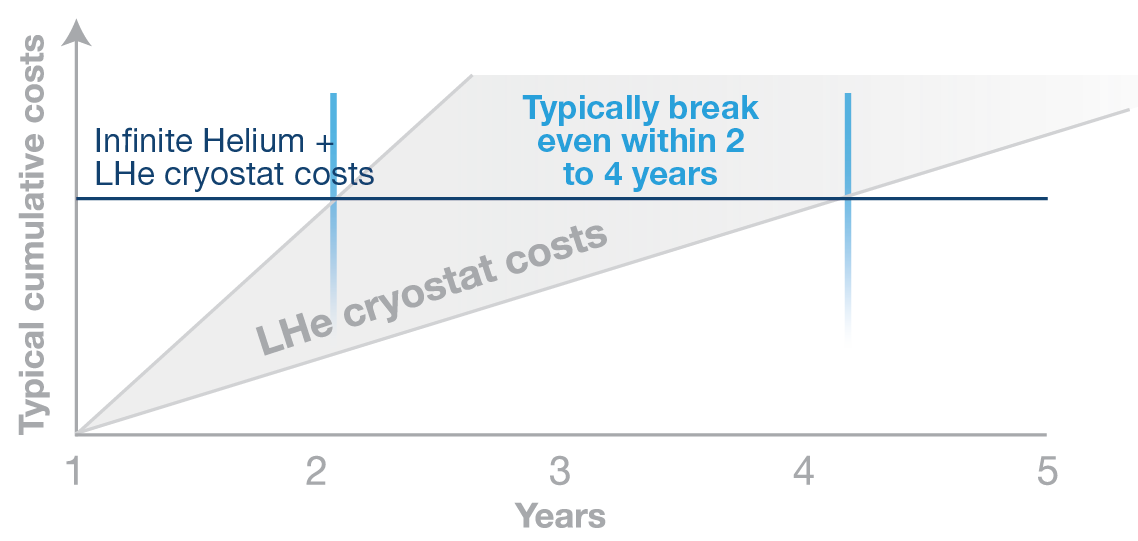
Labs typically break even within 2 to 4 years and benefit from:
- Significant reductions in helium consumption at the cryostat
- Fewer interruptions due to supply constraints
- Lower logistical effort for cylinder handling and ordering
- Improved scheduling certainty for long or critical runs
See how much you could save using our
📅helium calculator📅!
FREE DOWNLOAD
The Beginner’s Guide to Cryostats and Cryocoolers
The ultimate guide for scientists, students, and techs new to cryogenic systems operating from 1.5 to 300 K
Get the guide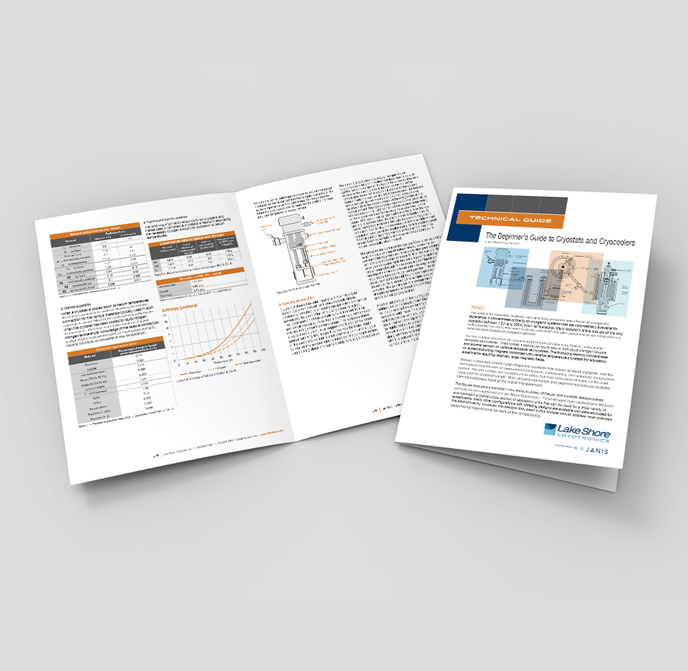
FREE DOWNLOAD
How to Deal
With the High
Cost of Helium
Learn real-world strategies for dealing with the cost and hassle of helium procurement, storage, and handling
Get the app note
Low Vibration
For vibration-sensitive microscopy applications in which the ST-500 cryostat is used, the low-vibration option offers best-in-class vibration levels. With less than 2 nm RMS vibration measured in X and Y, and less than 1 nm RMS vibration in the Z direction, the full package provides an ultra-stable platform for sensitive measurements. Centered on the transfer line between the ST-500 and Infinite Helium, the option’s components mitigate mechanical vibrations to aid in focal stability and measurement accuracy.
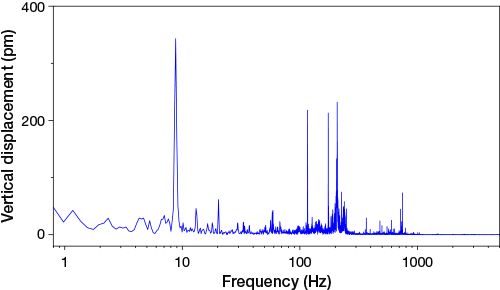
The low-vibration option for Infinite Helium provides less than 1 nm RMS vibration in the z direction
Beamline
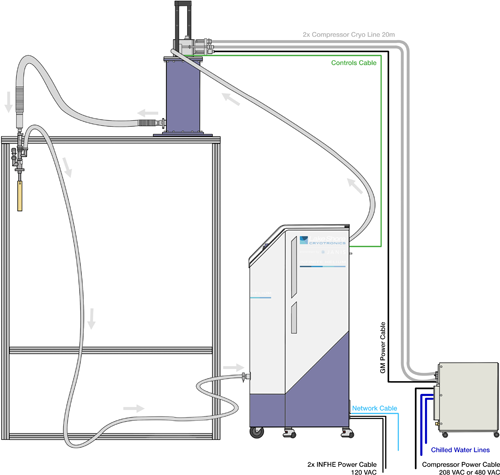
An option for synchrotron or beamline applications, the condensing cryostat of Infinite Helium can be suspended outside of the main enclosure, close to the working cryostat. This accommodates experimental space restrictions without sacrificing the cooling performance of Infinite Helium.