

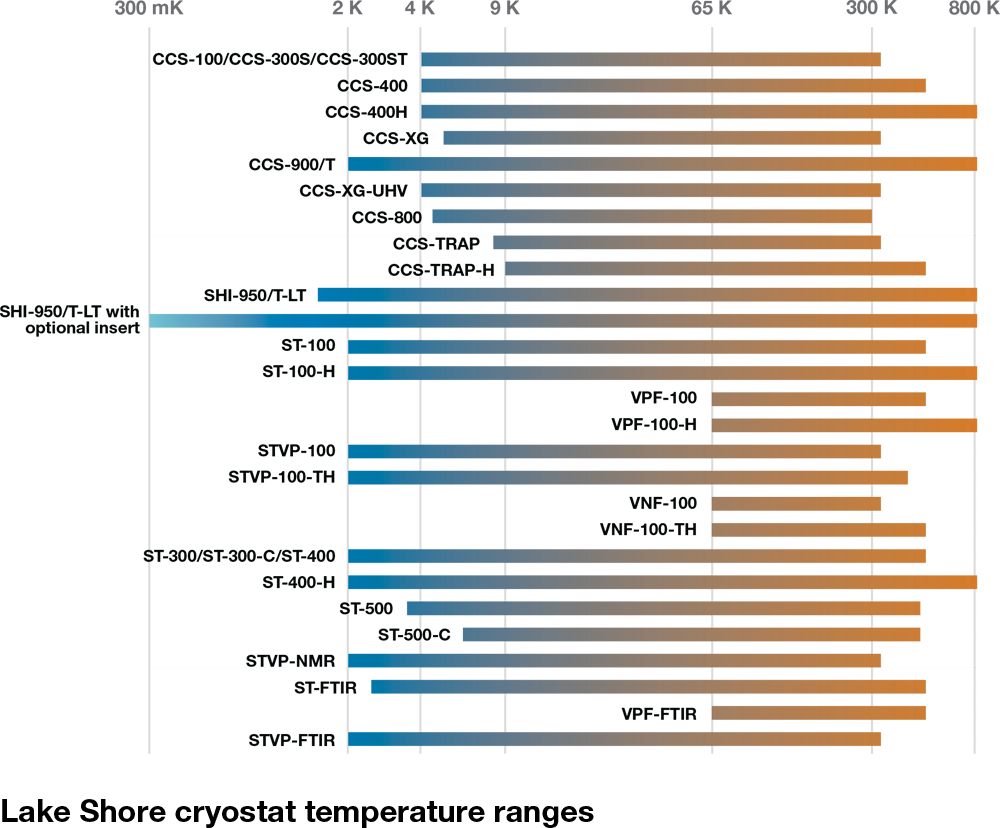
When it comes to precision measurements in physics and materials science, temperature control is everything. Cryostats provide stable environments for experiments at cryogenic temperatures; however, their capabilities differ significantly. Understanding the cryostat temperature range is essential for selecting the right system for your research.
Why cryostat temperature range matters
The temperature range of a cryostat determines what phenomena you can study. For example, superconductivity and quantum effects emerge only at extremely low temperatures, while certain spectroscopy techniques require elevated temperatures. Choosing a cryostat with the correct range ensures accurate data and protects your investment in instrumentation.
From millikelvin to hundreds of Kelvin
Cryostats are not one-size-fits-all. Some systems reach millikelvin temperatures for ultra-sensitive quantum experiments, while others operate at temperatures as high as 800 K for high-temperature material characterization. Lake Shore offers cryostats that span this entire spectrum:
Ultra-low temperatures (<2 K): Ideal for quantum computing, superconductivity, and low-temperature magnetism.
Intermediate range (4 K to 300 K): Common for transport measurements, magnetic property studies, and general condensed matter research.
High-temperature capabilities (up to 800 K): Perfect for spectroscopy, thermal analysis, and semiconductor characterization.
Matching temperature range to experimental needs
Selecting the right cryostat involves more than just hitting a target temperature. Consider your sample environment, measurement technique, and cooling method. Do you need optical access for spectroscopy or magnetic shielding for sensitive measurements? Will you use liquid helium/nitrogen or a closed-cycle cryocooler?
Lake Shore solutions
Lake Shore offers three main approaches to meet diverse experimental requirements:
Wet cryostat systems: Traditional liquid helium or nitrogen-based cooling for ultra-low temperatures.
Cryogen-free systems: Closed-cycle cryocoolers that eliminate the need for liquid cryogens, reducing operating costs and maintenance.
Infinite Helium technology: Enables continuous-flow wet cryostat operation without consuming additional cryogens, making it ideal for applications such as microscopy where uninterrupted cooling is critical.
These options enable researchers to select the optimal balance of temperature range, convenience, and cost tailored to their specific needs.
Understanding cryostat temperature ranges is the first step toward successful research. Whether you need millikelvin precision for quantum studies or high-temperature capability for spectroscopy, Lake Shore offers solutions that deliver accuracy, reliability, and flexibility.