

 Contamination can be one of the biggest challenges when performing temperature-dependent measurements of certain advanced materials. This is especially true for many emerging electronic and quantum materials, including TMDs and other 2D materials, organic semiconductors, van der Waals heterostructures, topological materials, ultra-thin superconducting films, and other air-sensitive structures whose electrical properties can be strongly influenced by surface adsorbates, oxidation, and other forms of ambient contamination.
Cryogenic probe stations provide certain advantages for studies of these materials. Not only do they enable non-destructive, on-wafer electrical characterization using repositionable, micromanipulated probes — reducing the need for permanent device packaging or wire bonding of delicate structures during early-stage research — but they also provide a high-vacuum measurement environment. At pressures ranging from 10⁻⁵ to 10⁻⁷ Torr, this environment helps minimize exposure of samples to moisture, oxygen, and other atmospheric contaminants, which is particularly important for materials with a high surface-to-volume ratio, where even trace contamination can significantly alter or obscure intrinsic device behavior.
And for applications involving samples especially sensitive to contamination or condensation, Lake Shore also offers a high vacuum kit (PS-HV-CPX) for its CPX, CPX-VF, and CRX-VF stations. This kit lowers the ultimate base pressure by up to two decades and reduces pump-down time, helping prevent condensation from accumulating on the sample during cooldown.
However, for organic electronic materials and other particularly sensitive samples, maintaining sample integrity during transfer can be just as important as preserving the measurement environment itself. To address this, we offer two options for our CPX, CPX-VF, and CRX-VF stations: the PS-LL-CPX load-lock option and the PS-SC-CPX suitcase option.
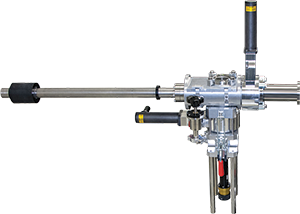 The load-lock option enables sample exchange without warming radiation shields or breaking vacuum. It reduces cycle time to about 1 hour on the CPX or CPX-VF and approximately 2 hours on the CRX-VF, and includes an electrically isolated sample-stage adapter, modified radiation shields, and dedicated transfer holders for secure loading.
The specialized suitcase is for even more stringent contamination control when using the load-lock. It enables quick sample transfers between controlled environments and features a vacuum flange adaptable for standard glovebox fittings. A sample is loaded into the suitcase, and once the suitcase is mounted on the underside of the load-lock chamber, the sample can be shuttled to the cold stage with ease. This approach is particularly beneficial for fragile materials such as atomically thin TMD structures.
Together, these options help enable controlled-environment experimental workflows, allowing researchers to probe air-sensitive materials with greater confidence and repeatability.